
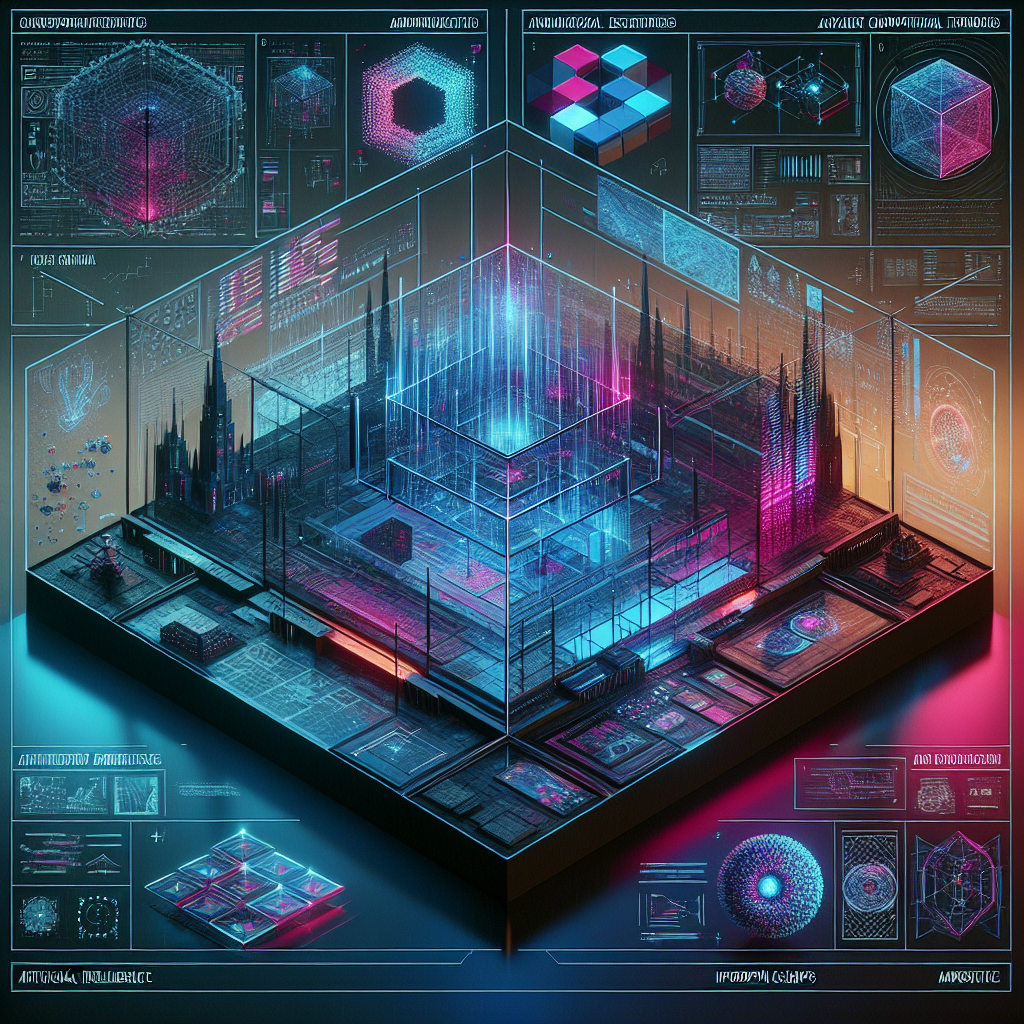
M.C. Escher’s art transports us into a realm of impossible realities with its mind-bending illustrations. These optical illusions, characterized by their complex shapes, challenge our understanding of physics and open doors to creative exploration. To aid in this exploration, researchers at MIT’s Computer Science and Artificial Intelligence Laboratory (CSAIL) have developed an innovative tool called “Meschers”. This unique tool represents what are known as “physically impossible” objects by producing 2.5-dimensional structures that can be manipulated and analyzed while maintaining their illusory properties.
The Meschers tool allows users to convert both images and 3D models into structures that resemble Escher-like designs. It offers functionalities such as relighting, smoothing, and the ability to study their complex geometries, which can be particularly beneficial to both artists and scientists. By enabling these visually perplexing shapes to be defined in a computationally consistent manner, Meschers enhances our understanding of both geometry and perception.
At the core of the tool’s capability lies the simulation of impossibility without losing local consistency. For instance, consider the Penrose Triangle—an impossible object that features regions we perceive as 3D while also inherently conflicting in geometry. Meschers studies these conflicting geometries and allows creatives to build upon them. This enables artists to generate unique designs that would otherwise be challenging to visualize using traditional methods.
The potential applications of Meschers extend beyond art. For researchers, it could facilitate geometric calculations on impossible objects, such as measuring distances across curved surfaces, determining light diffusion, and even simulating heat transfer. These features grant users unprecedented access to understanding the domain of impossible shapes — a significant leap from abstract theories to tangible explorations.
As the lead author Ana Dodik emphasizes, Meschers is not just a tool for digital artists; it unlocks new avenues for understanding perception itself, helping scientists recognize the boundaries of what makes an object appear impossible. The implications are vast, suggesting that, with tools like Meschers, creative expression does not have to conform to the rules of physical reality, thus fundamentally changing how artists can conceptualize their work.
Meschers showcases the symbiosis between computer science and the arts, emphasizing that technology can significantly enhance artistic expression. With ongoing plans to streamline the tool’s interface for ease of use, the researchers at CSAIL continue to evolve Meschers into a more robust platform. This could enable broader applications in both design and scientific research while facilitating future collaborations across disciplines.
Want to explore how AI can optimize your business or automate key workflows? Book a free 15-minute call with Kick-Start.ai to get personalized help.
In wrapping up, the Meschers tool marks a significant step into the realm of impossible geometric representations. It creates opportunities for artists to transcend conventional mediums while empowering researchers with novel perspectives on geometry. This intersection of creativity and technology invites us to imagine what wonders lie at the fringes of possibility — where artistic imagination meets the constraints of our physical world.