
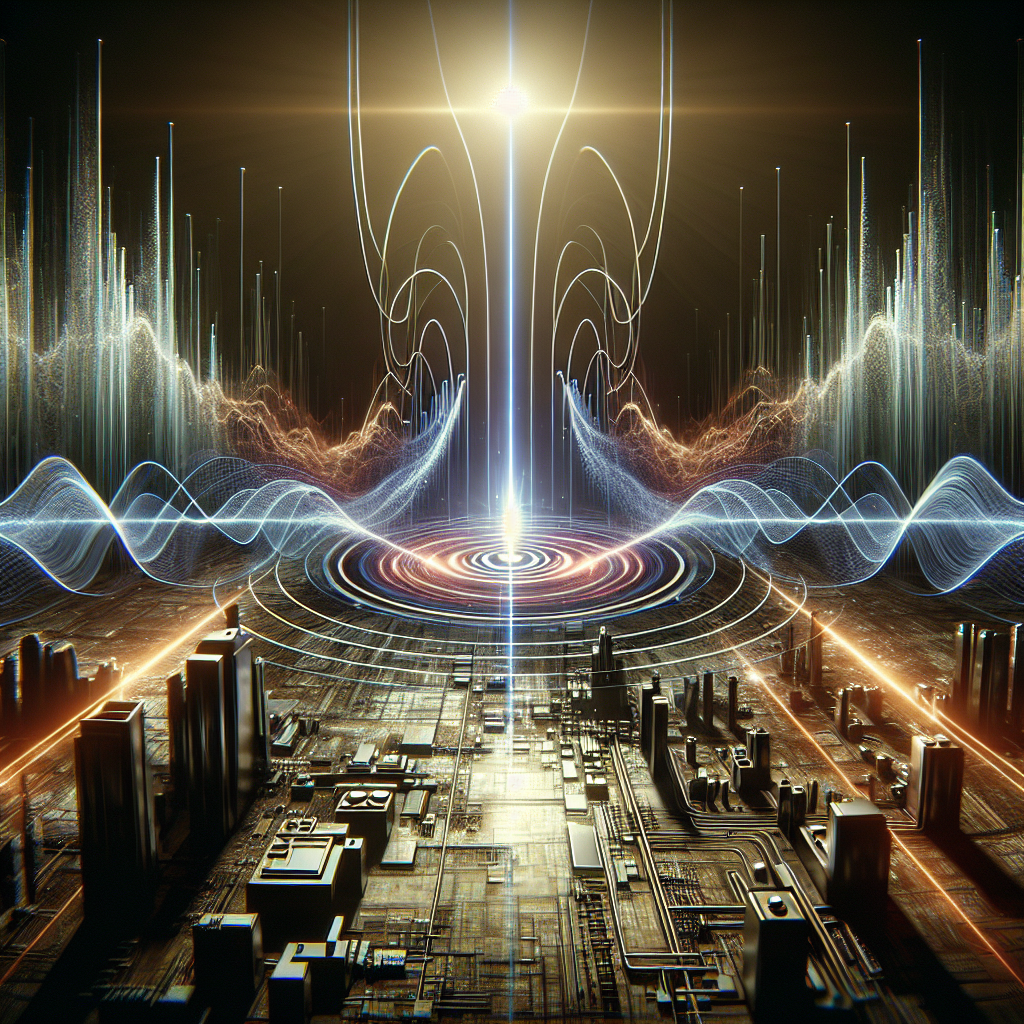
In an unprecedented breakthrough, researchers at Caltech have extended the memory of quantum computers by up to 30 times through an innovative process that converts quantum information into sound waves. This advancement marks a significant step toward making quantum computing more practical and scalable, addressing one of the long-standing challenges faced by quantum engineers: storing quantum data reliably over extended periods.
Traditional quantum computers utilize superconducting qubits, which excel in executing swift calculations but struggle to retain information for long durations. The innovative technique developed by the Caltech team involves using a miniature device called a mechanical oscillator—essentially a tiny tuning fork—that vibrates at gigahertz frequencies. This device effectively stores quantum states by translating them into sound waves, providing a method for quantum information to be retained much longer than previously achievable with superconducting systems.
The research team, led by graduate students Alkim Bozkurt and Omid Golami under the guidance of Mohammad Mirhosseini, introduced this hybrid quantum memory system in their paper published in *Nature Physics*. The significance of this work lies in its potential to dramatically enhance the quantum memory capabilities of superconducting qubits, which are crucial for quantum computing applications.
Creating a robust quantum memory is essential to the future of quantum technology. As Mirhosseini aptly remarked, when a quantum state is generated, it is not always necessary to act upon it immediately; having the capacity to return to that state after a period is vital for effective computations. This innovative quantum memory system provides that ability, empowering researchers to manage quantum information with unprecedented efficiency.
A crucial advantage of this new method is its utilization of sound waves, which travel more slowly compared to electromagnetic waves. This slower propagation allows for the construction of more compact devices and significantly less energy loss, providing an avenue for improved scalability. Additionally, mechanical vibrations—as opposed to electromagnetic waves—are more restricted in their propagation, minimizing energy dissipation and interference with nearby devices. The result is a quantum memory device that promises not just longer lifetimes, but also enhanced reliability.
As the researchers meticulously measured the oscillator’s capabilities, they found that its retention times for quantum information outpaced existing superconducting qubits by a staggering factor of 30. Mirhosseini’s team is already looking ahead to the next steps, with future work aimed at increasing the interaction rates of this hybrid system to enable even faster retrieval and processing of quantum data. This breakthrough not only boosts the operational efficacy of quantum computers but also lights the path toward more complex and capable quantum systems capable of tackling multifaceted problems.
Want to explore how AI can optimize your business or automate key workflows? Book a free 15-minute call with Kick-Start.ai to get personalized help.
The implications of this research extend beyond academic curiosity; the enhancements in quantum memory could lead to significant advancements in areas such as cryptography, materials science, and drug discovery, among others. As we continue to push the boundaries of quantum mechanics and practical applications, breakthroughs like these will serve as the foundational blocks needed to realize the full potential of quantum computing technologies. In summary, the work led by Caltech researchers illustrates not only a theoretical triumph but a practical leap towards scalable, effective quantum computing solutions that could soon make an extraordinary impact on our technological landscape.