
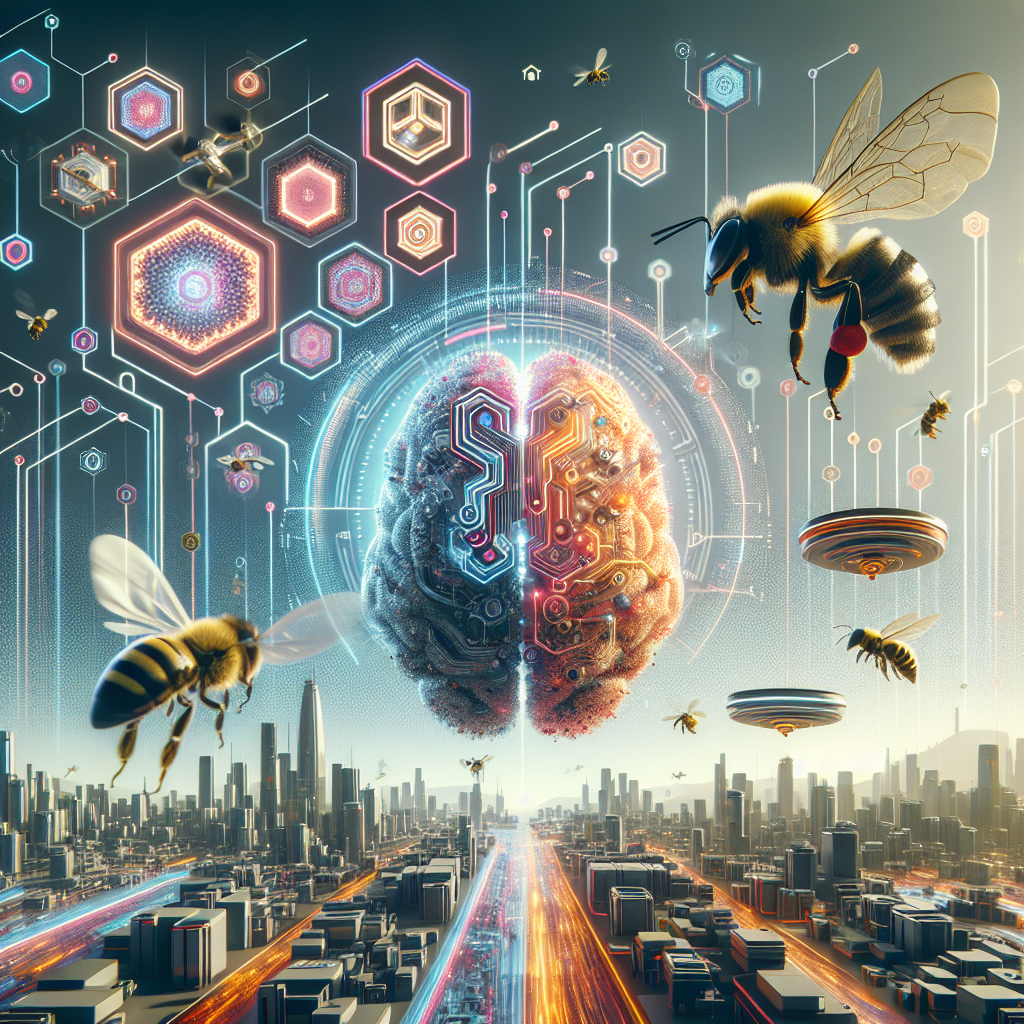
The tiny brains of bees, often considered simplistic, have unveiled a remarkable secret: they utilize their flight movements to enhance their brain signals, enabling them to recognize visual patterns with incredible precision. This groundbreaking research from the University of Sheffield is prompting a rethink of how we develop next-generation artificial intelligence and robotics, emphasizing efficiency over sheer computational power.
Bees, despite their diminutive size, boast a surprisingly sophisticated ability to learn and process complex visual information. By constructing a digital model that simulates a bee’s brain, researchers have uncovered the intricate connection between flight mechanics and cognitive function. This new approach reveals that as bees navigate through their environments, their movements help shape and clarify the visual data that reaches their brains, resulting in streamlined neural responses. This insight sheds light on how intelligence can be designed to be efficient, even within minimal structural confines.
One of the major findings from this study is the significance of movement in enhancing perception. Professor James Marshall, director of the Centre of Machine Intelligence at the University of Sheffield, explains that even the simplest brains—like those of bees—can use their physical interactions with the environment to perform complex tasks. This challenges the conventional view that greater brain size necessarily correlates with intelligence, underscoring that functionality can also stem from the efficiency of neural networks and their interaction with the surrounding environment.
The implications of these discoveries stretch far beyond just understanding bee behavior. They suggest a blueprint for developing more effective artificial intelligence systems that leverage movement and context in real-world settings. Going forward, AI could be designed to adapt and learn from its activities similarly to how bees refine their cognitive processes in flight. This move toward incorporating bodily actions into AI learning could lead to robots that require less computational power while still demonstrating superior learning capabilities.
The study also emphasizes how interdependent the relationship is between cognition, physicality, and environmental interaction. It suggests that for robots to replicate nimble, intelligent behavior, they need to harmoniously integrate their sensory feedback with their movement. For AI practitioners, this research highlights the potential ease with which robots could be designed to navigate complex tasks with fewer resources, ultimately paving the way for advancements in various fields including robotics, autonomous vehicles, and even cognitive computing.
Want to explore how AI can optimize your business or automate key workflows? Book a free 15-minute call with Kick-Start.ai to get personalized help.
In conclusion, the discoveries surrounding bee brains present a tantalizing glimpse into the future of intelligent systems. By focusing on efficiency and the synergy of movement and cognition, we could significantly enhance AI design and functionality in ways that previous paradigms did not envision. Recognizing the remarkable capabilities of even the smallest brains reminds us that nature often holds the keys to innovation, providing us with lessons that can trigger a new era in technology development.